
Hello friends,
Thank you Elizabeth, the wonderful staff and board of the Dispute Resolution Center for your ongoing work and for bringing us together today..
I titled my remarks: The strength of community.
On the surface, the title is both declarative and aspirational. The strength of community.
It asserts that there is strength to be found, to be had in community. It projects a confident message of possibility.
But… in a certain way, it is also an incomplete statement.
If there is strength in community, what is it? What makes a community strong?
The word “Community” originates from Latin. It combines con-(”together”) and munis (”performing services” “endeavors”), highlighting a group bound by shared interests, location, or responsibilities.
Such a definition automatically begs two foundational questions:
First: Who is my community?
Second: What makes a community strong?
Let’s start with
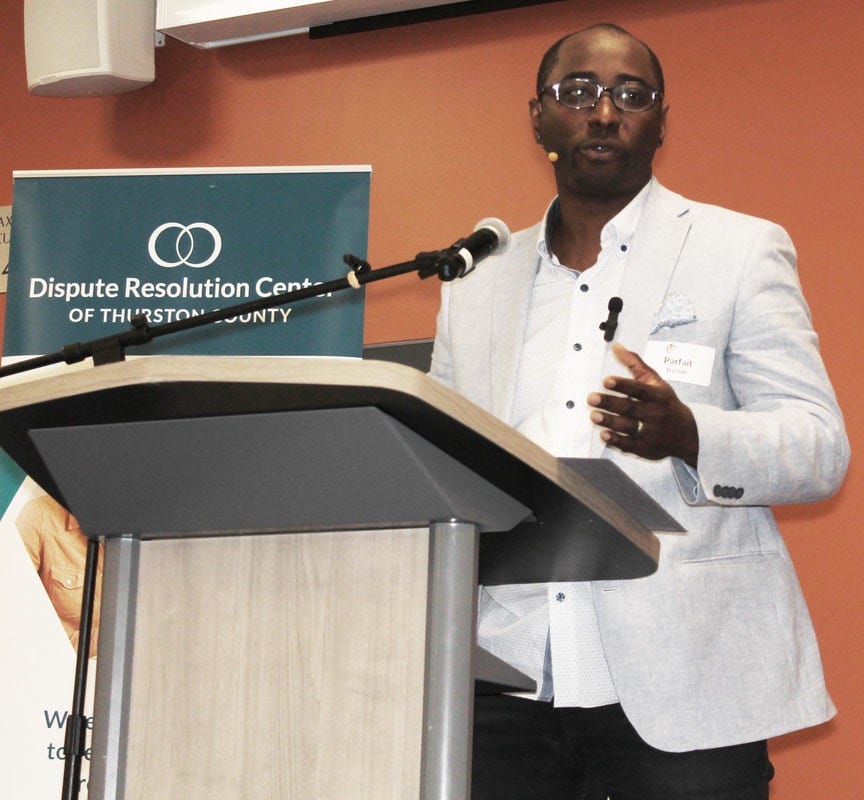
Who is my community?
Is my community those I like?
Is my community, those who live like me?
Is my community those who think like me?
Look like me?
Worship like me?
Eat like me?
Advocate like me?
Or vote like me?
In August 2000 when I first moved to the USA from Senegal republic, unbeknownst to me, I joined a new community. The American community. One that I had idealized as a child growing up. One marked by technological, military and cultural might.
Yet…. an imperfect community.
One made of not so perfect individuals. Some of whom would tell me I did not belong here either because of my religious beliefs, my race, my accent or my origin.
Some of whom would ask me the most horrendous questions due to racial stereotypes or plain simple ignorance.
So there was the question I had to wrestle with.
Were these people also part of my new American community? Should they be considered as such?
Initially, and most naturally, I answered the question with an emphatic “No”.
Taking offense, isolating, and becoming selective about who I let near was instinctive. Plus it felt good and comfortable.
So, I built defenses –walls to protect myself from future hurt and I started looking for my people. The safe ones.
But there was a danger in that approach. A blind spot; a deep vulnerability to this type of community design. It risked being homogeneous. Weakened by its own walls made of hollow and wobbly bricks of fear and righteous indignation.
It risked constricting the capabilities of the heart to love –limiting my experience of community to an ever shrinking circle of uniformity.
What I was building out of hurt and self-righteousness was not a community. It was a support group at best.
A fan club.
An echo chamber that failed to challenge the simplistic and convenient storylines I was telling myself about the other.
That is not community.
Yet, I fear that we are making the same collective mistake.
If we are to believe the most recent data, 1/3rd of every adult is experiencing loneliness. Half of our youth is experiencing loneliness.64% of Americans report not belonging in the workplace. 68% report not belonging in the country period. And 74% report non belonging in their local community.
Decades of research now prove what we knew intuitively: the direct correlation between these numbers and health outcomes, and even life expectancy.
And the most surprising finding from the research is this following counter intuitive correlation: There tends to be a greater experience of belonging when one’s community is diverse.
Selective community design along tribal lines is confining us into smaller bubbles and is literally killing us.
That is not community.
So what is community then?
A friend of mine back in Senegal I used to call regularly during my first few years in the USA to vent and complain about my new American community.
Was courageous, curious and compassionate once and spoke to me, truth in love.
He told me, Parfait, I hear you, I empathize with you AND, you are doing the very same thing you are complaining about.You are othering those who are othering you.
In other words you are being a hypocrite. It hit me hard. and that’s how I wrote the song Let’s face it.
Song Let’s Face it
What the song highlights and what I have come to learn is that true community is Love’s training ground. A divine assignment in civic and spiritual formation.
A place we are assigned to. With people we may not choose.
A place filled with people we may or may not like.
Agree or disagree with. But with whom we are bound by location and shared interest in the pursuit of human flourishing.
A place where we get to practice service for the common good, hospitality, curiosity, courage in truth telling, forgiveness, repair and restoration.
A place where we wrestle with nuance and in the face of profound difference, grow in our capacity to love.
And in my non co-opted Christian faith tradition, a place where we ought to seek to be at peace with all. Peace makers.
Not turn others into us, but live, learn and liberate one another from the shackles of our tribal identities.
If this is who my community is: a conglomeration of imperfect people who will likely drive me nuts at times,
What makes a community strong then?
May I suggest: Befriending. Movement towards one another.
Movement towards imperfect people, in unexpected acts of courage, curiosity and compassion that end up liberating us all. Both the befriender and the befriended from the shackles and constriction ‘of our tribal identities.
Not reckless exposure to harm. Not a lack of boundaries or accountability. But a commitment to not reduce people to their worst moments, decisions or even developmental stage.
A commitment to be a faithful AND truthful friend to another imperfect human being.
A commitment to being a friend in the arena– love’s arena.
And just like my friend who told me the truth in love.
An invitation to Be A friend because the strength of community is in befriending the other.
You may now ask how?
Here is a short acronym to guide you on this journey. F.R.I.E.N.D.
The F in friend is for Face yourself often – muster the courage to sit with doubt, hold the mirror and to not only question the storylines we tell ourselves about the other but also question our certainties.
The R in friend is for an invitation to Reach out and Reciprocate often. Befriending is leadership. It is intentional, relational and most importantly, transformational.
The I is an invitation to lead with Inquiry and be curious about the other, their drivers and the stories that shaped how they think and behave.
The E in friend is for Extending grace. Be forgiving. Not excusing harm. But recognizing that we are all fallible, on a developmental journey and in frequent need of forgiveness too.
The N is for Normalizing difference. Not accepting all ideas as equal but recognizing that dehumanization does not change nor heal people. Befriending does.
Finally, the D is for Doing it again, again and again. Being a friend is not an event, it is a way of being. It’s how we strengthen our community.
Thank you!
Watch the speech here.
Such a wonderful article. Thank you my friend. And thank you for befriending me so many years ago.